
Last updated: August 2026 · Reviewed by the Blessings Healthcare Solutions equipment team
How to Choose the Right ECG Machine for Your Clinic or Hospital
The right ECG machine for your facility comes down to five decisions: channel count, daily patient volume, portability, EMR/HIS connectivity, and after-sales support. A 3-channel unit that works fine for a two-doctor clinic will bottleneck a 200-bed hospital’s OPD, while a full 12-channel hospital-grade system is often unnecessary expense for a diagnostic centre doing routine screenings. Cardiovascular disease is the world’s leading cause of death, so the ECG you buy isn’t just equipment on an invoice — it’s the first line of detection for a condition that kills faster than almost anything else. This guide breaks down exactly what to check before you sign a purchase order, which features are worth paying more for, and the mistakes that cost Indian clinics and hospitals money every year.
Why the Right ECG Machine Matters More Than a Line Item
Cardiovascular disease caused an estimated 19.8 million deaths worldwide in a recent year — close to one in three deaths globally — and roughly 85% of those were from heart attacks and strokes, conditions an ECG is often the first tool to flag. In India, the picture is more urgent: the age-standardised cardiovascular death rate runs well above the global average, and heart disease tends to strike Indians roughly a decade earlier than it does populations in the West. That combination — higher risk, earlier onset — is exactly why relying on an outdated or mismatched ECG system isn’t a minor operational gap. A machine that takes too long to acquire a clean reading, or one that a busy OPD staff finds unintuitive, directly delays the moment a cardiac event gets caught.
This is also why “buy the cheapest one that works” is the wrong lens. The right question isn’t which ECG machine is cheapest — it’s which ECG machine matches how many patients you’ll actually test, how experienced your staff are, and what your reporting workflow needs to look like.
Key Features to Check Before You Buy (ECG machine buying guide)
1. Number of Channels
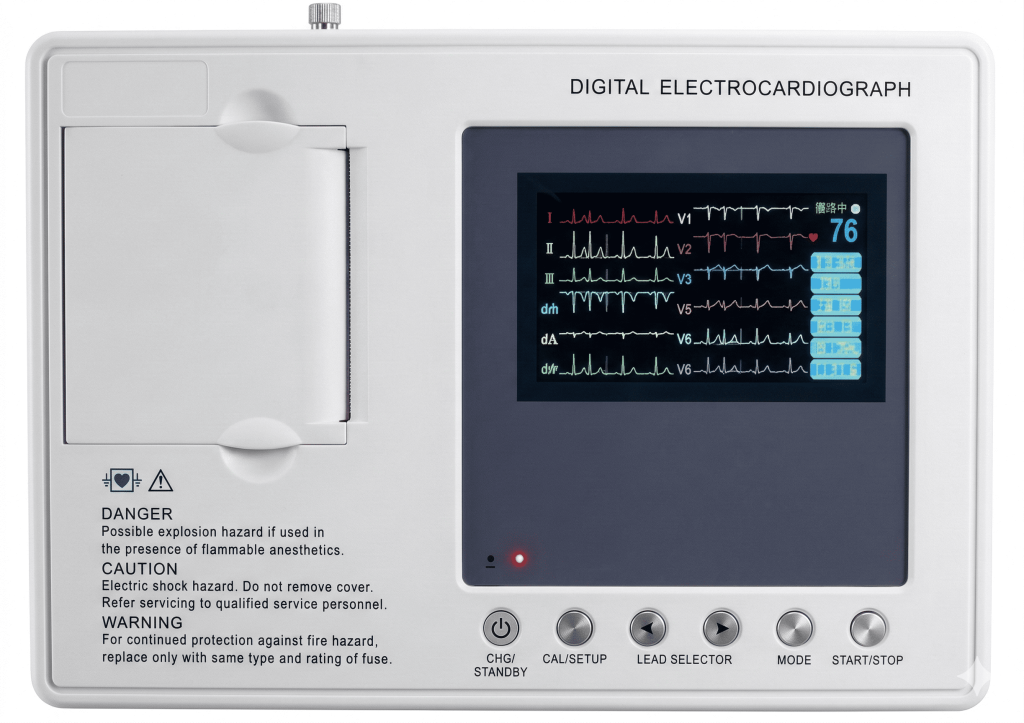
This is the single biggest factor in both price and speed. A single-channel machine records one lead at a time — slow, but the cheapest entry point. A 3-channel machine captures a full 12-lead ECG but prints it in four segments, which is perfectly diagnostic and remains the most cost-effective choice for small and mid-sized clinics. A 6- or 12-channel machine prints all 12 leads simultaneously on one page, cutting reporting time significantly — the difference matters in emergency departments and high-volume cardiology units, but it’s often unnecessary spend for a clinic doing a handful of ECGs a day.
2. Display, Interface & Reporting Speed
A clear, high-resolution digital display lets clinicians catch waveform abnormalities at a glance, and a touchscreen interface reduces training time for new staff. In an emergency department especially, a confusing menu system costs seconds you don’t have. Ask for a live demo, not just a spec sheet — interface quality is something you feel, not something you can judge from a brochure.
3. Portability and Battery Backup
If the machine will move between wards, do bedside monitoring, or support home visits and mobile health camps, prioritise lightweight builds (ideally under 2 kg) and a battery that comfortably covers a full shift — 4 to 8 hours is a reasonable benchmark. A machine that dies mid-round or needs to stay tethered to a wall socket defeats the purpose of portability.
4. Data Storage & EMR/HIS Connectivity
Modern ECG machines can store hundreds of patient records internally and export via USB, Wi-Fi, or Bluetooth. Before you buy, confirm two things: how many reports the internal memory holds, and whether the machine can integrate with your existing hospital information system or EMR software. A machine that can’t talk to your existing records system means someone is manually re-typing patient data — a workflow tax you’ll pay every single day you own the device.
5. Built-In Interpretation Algorithms
Many mid-range and higher-end machines now include automated interpretation, flagging likely arrhythmias or ischemic changes as a preliminary read. This isn’t a replacement for clinical judgement, but in a resource-limited setting without an on-call cardiologist, it’s a genuinely useful second check. If interpretation accuracy matters to your buying decision, ask the supplier for validation data on the algorithm used, rather than taking the claim at face value.
6. Build Quality, Lead Wires & Ongoing Consumable Costs
The upfront price tag is only part of the cost. Electrodes, recording paper, and lead wires are recurring expenses, and lead wire quality in particular affects how often you’ll be troubleshooting signal noise. When comparing two machines at a similar price, ask what a year of consumables costs for each — the cheaper machine on day one isn’t always the cheaper machine by year two.
7. Certifications and Compliance
In India, confirm CDSCO registration for the device; internationally, look for CE marking and ISO 13485 manufacturing certification. These aren’t just paperwork — they’re your assurance that the device has passed electrical safety and clinical accuracy testing, and they matter if your facility is ever audited or accredited.
8. Warranty and Local Service Support
This is the feature buyers skip past and regret later. A machine with a great spec sheet is only as good as the supplier’s ability to fix it when a lead wire fails or a battery degrades. Ask specifically: what’s the warranty period, is there a local service technician, how fast is typical turnaround for a repair, and are spare parts stocked in-country or imported on request. A supplier who can answer this clearly, with real timelines, is telling you more about long-term reliability than any brochure will.
Matching the Machine to Your Facility
Small clinics and private practices generally do best with a compact 3-channel digital ECG — enough diagnostic detail for routine screening, lower consumable costs, and a smaller footprint on a crowded consulting-room desk.
Multi-specialty hospitals with emergency departments and cardiology units should lean toward 6- or 12-channel systems with EMR integration and fast report turnaround, since the volume and urgency of cases justify the higher upfront cost.
Diagnostic centres and labs running routine screening at volume benefit most from machines with strong data storage, quick export to referring physicians, and dependable throughput — speed of reporting is often more valuable here than channel count alone.
Ambulances and mobile health units need the lightest, most battery-resilient portable units available, ideally with wireless transmission so a reading can reach a specialist before the patient even arrives.
Common Mistakes Facilities Make When Buying an ECG Machine
- Buying on price alone. The cheapest unit on the quote sheet often has the weakest after-sales support, which becomes expensive the first time it breaks down mid-week.
- Skipping the EMR compatibility check. Discovering post-purchase that a machine can’t export to your hospital software means months of manual data entry.
- Ignoring consumable and AMC costs. A lower sticker price with expensive proprietary electrodes or paper can cost more over three years than a slightly pricier machine with standard consumables.
- Not verifying certifications. Skipping the CDSCO/CE/ISO check can create compliance headaches during accreditation or audits.
- Underestimating patient volume growth. Buying a machine sized for today’s patient count, rather than next year’s, often means a second purchase sooner than planned.
How Technology Is Changing Cardiac Diagnostics
ECG machines have moved well past simple paper-based recorders. The current generation increasingly includes AI-assisted interpretation, cloud-based report storage, and connectivity that supports telemedicine — a cardiologist in another city can review a reading minutes after it’s taken. For facilities investing in long-term infrastructure, this shift matters: an ECG system purchased today should ideally support remote consultations and integrated patient monitoring, not just standalone recording, since that’s the direction the entire category is heading.
Frequently Asked Questions
What is the difference between a 3-channel and a 12-channel ECG machine? Both capture a full 12-lead ECG. A 3-channel machine prints the leads in four segments, taking longer to produce a complete report, while a 12-channel machine prints all 12 leads on one page in seconds. Diagnostically they’re equivalent — the difference is reporting speed and, generally, price.
How many leads does a standard ECG machine use? A standard clinical ECG uses 12 leads, generated from 10 electrodes placed on the limbs and chest. This gives clinicians 12 different electrical views of the heart, which is the diagnostic standard for detecting arrhythmias, ischemia, and conduction abnormalities.
Is a portable ECG machine as accurate as a standard one? Yes, a quality portable ECG machine offers the same diagnostic accuracy as a standard unit — the difference lies in form factor, battery life, and durability for mobile use, not signal quality. Accuracy depends more on the model’s electronics and lead wire quality than on whether it’s portable.
How much does an ECG machine cost in India? Prices vary widely by channel count and features: single-channel units typically start around ₹18,000–₹25,000, 3-channel machines run roughly ₹25,000–₹60,000, and 6- to 12-channel systems range from about ₹30,000 up to ₹1,20,000 or more for advanced hospital-grade models. Connectivity, touchscreen displays, and interpretation software all push the price higher.
What certifications should an ECG machine have? At minimum, look for CDSCO registration for use in India, along with CE marking and ISO 13485 certification from the manufacturer. These confirm the device has passed electrical safety and clinical accuracy testing required for medical use.
How often should an ECG machine be serviced or calibrated? Most manufacturers recommend annual calibration to maintain diagnostic accuracy, alongside routine checks of lead wires, electrodes, and battery health. Facilities with heavy daily usage may benefit from a service check every six months.
Can an ECG machine connect to hospital EMR or HIS software? Modern ECG machines generally support USB, Wi-Fi, or Bluetooth data export, and many integrate directly with EMR or hospital information systems via DICOM or HL7 standards. It’s worth confirming compatibility with your specific software before purchase, since not every machine integrates with every EMR platform.
Conclusion
Choosing an ECG machine isn’t a purchasing decision you make once and forget — it’s an investment in how quickly your facility can catch a cardiac event before it becomes an emergency. Channel count, connectivity, portability, and the strength of your supplier’s after-sales support all matter more than the number on the price tag. Get the fit right for your patient volume and workflow, and the machine pays for itself in diagnostic speed and staff confidence.
Not sure which ECG machine fits your facility? Blessings Healthcare Solutions works with hospitals, clinics, and diagnostic centres across Varanasi and beyond to match equipment to real clinical needs — not just a spec sheet. Contact us via WhatsApp or through our Contact Page for a quick requirement assessment and a recommendation suited to your patient volume and budget.